Before Paying a Yiwu Supplier Deposit: 12 Checks for Buyers
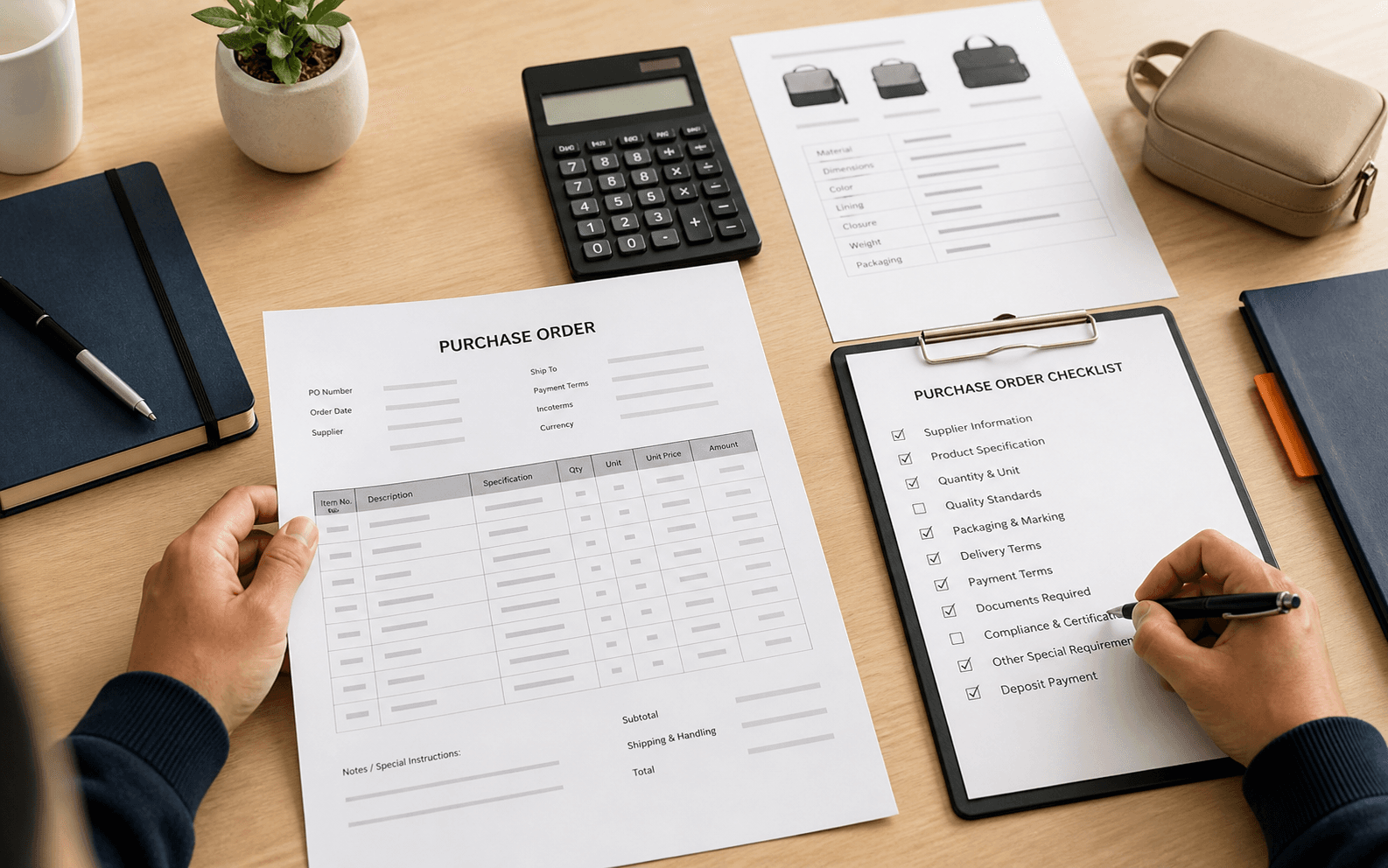
A supplier asking for a deposit does not mean the order is ready for payment. Before money moves, the buyer should be able to identify the contracting company, exact product, approved reference, quantity, packaging, delivery responsibility, production timing, inspection trigger, and beneficiary in one consistent order file.
Quick answer
What should a buyer check before paying a Yiwu supplier deposit?
Do not pay until the supplier identity, beneficiary, product specification, quantity, unit price, total amount, sample or reference, packaging, artwork, lead time, delivery term, inspection plan, and balance trigger agree across the quotation, pro forma invoice, purchase order, and messages. Resolve contradictions in a corrected document rather than relying on a chat promise.
Overview
The commonly discussed 30% deposit and 70% balance is a commercial arrangement, not a safety rule. A smaller deposit cannot fix an unclear specification, and a familiar supplier cannot manufacture details that were never written down. The useful question is what the deposit authorizes the supplier to buy, make, print, or reserve—and what evidence controls the next payment.
Documents should answer different parts of the same order
Swipe to view all columns
| Record | What it should establish | Warning sign |
|---|---|---|
| Quotation | Specification basis, quantity tier, unit price, packaging, and validity | The cheapest line lacks material, size, packaging, or MOQ detail |
| Pro forma invoice | Seller, buyer, products, totals, currency, payment stages, and beneficiary | The seller or amount differs from the approved quotation without explanation |
| Purchase order or contract | The complete commercial agreement and responsibilities | Important terms remain only in chat messages |
| Approved sample or artwork | The physical or visual reference for production | The supplier is told to start while color, logo, or packaging is still being revised |
| Inspection instruction | What will be checked and when the balance may be released | The balance is due simply when the supplier says production is finished |
How to apply this
- Confirm the legal supplier — Record the Chinese company name, business-license details, address, and responsible contact. A booth sign, English nickname, or marketplace profile may not be the contracting entity.
- Match the beneficiary — Compare the bank-account holder with the seller named on the invoice or contract. If another company or a personal account is proposed, obtain a written explanation and review the invoicing, export, and recovery implications before paying.
- Freeze the product specification — Write down model, material, dimensions, color, finish, function, accessories, tolerance, and any destination-specific requirement. Product photos alone are rarely a complete specification.
- Define the approved reference — State whether production follows a stock sample, customized sample, signed sample, drawing, artwork, or specification sheet. Give the reference a date or version so later revisions are visible.
- Reconcile quantity and MOQ — Confirm total quantity and whether MOQ applies per design, color, size, model, or packaging version. Check carton assortment if several SKUs will share the order.
- Recalculate the money — Multiply each confirmed quantity by its unit price, then add molds, printing plates, packaging, labeling, samples, domestic delivery, tax, or other agreed charges. The pro forma invoice total should be reproducible.
- State what the quoted price includes — Record the Incoterm or delivery point and named place where relevant. EXW, delivery to a Yiwu warehouse, FOB, and a door-delivered offer assign different costs and responsibilities.
- Approve packaging and shipping marks — Confirm unit packaging, inner packs, carton quantity, expected carton strength, labels, barcodes, warnings, and outer marks. Packaging changes can affect both product cost and freight cost.
- Lock artwork and customization — Check logo spelling, dimensions, color references, print position, label language, barcode data, and file version. Do not release a customization deposit while the artwork is still described as final later.
- Agree on production timing — Define when lead time starts, what buyer approvals can pause it, and the expected completion or delivery date. Separate a production estimate from a guaranteed shipping connection.
- Define inspection and correction — Specify whether there will be sample approval, during-production checking, pre-shipment inspection, or warehouse verification. State who pays for rework or reinspection when the order does not match.
- Write the balance trigger — Tie the next payment to evidence such as approved inspection, confirmed finished quantity, corrected defects, or accepted warehouse receipt. Keep the transfer reference and supplier receipt with the order file.
Mistakes to avoid
- Treating a 30% deposit as automatically safe because the percentage sounds standard.
- Paying from a quotation while the supplier expects to manufacture from later chat messages.
- Approving the unit price without adding molds, packaging, labels, local delivery, or tax treatment.
- Using an unversioned product photo as the only quality reference.
- Accepting a beneficiary change without independent verification through a previously trusted contact.
- Letting the balance become due at production completion without defining inspection and correction.
- Booking a fixed shipping connection before the supplier has a reliable completion date.
Practical recommendation
Recommended next move
Create one payment-release page at the front of the order file. It should show the supplier, beneficiary, order total, deposit amount, approved specification and reference, production deadline, delivery point, inspection event, and balance-release condition. If any line cannot be completed, the order probably needs clarification before payment. Use Sourcing Help when the supplier, specification, quotation, or production plan still needs work; use the Supplier Payment mode when a genuine documented order exists but the cross-border payment structure needs review.
Useful related guides
Frequently asked questions
Is a 30% deposit normal for Yiwu suppliers?
It is common for some production orders, but it is not universal and does not prove that an order is safe. Stock status, customization, materials, order value, supplier relationship, and bargaining position can change the percentage. The specification and payment triggers matter more than copying a standard ratio.
Should I pay a deposit before approving a sample?
For customized or quality-sensitive goods, the buyer should normally define and approve the relevant reference before authorizing bulk production. A separate sample or development fee may be reasonable, but it should not be confused with approval to produce an unresolved bulk order.
What if the supplier says the price will expire today?
Ask what input changed and request a dated quotation with a stated validity period. Material or exchange-rate movement can be real, but urgency should not replace identity, specification, beneficiary, or document checks. A cheap price on an unclear order is not a secured saving.
When should the balance be paid?
Use a written release condition appropriate to the order, commonly after agreed production evidence and inspection but before shipment release. The exact timing depends on the contract and supplier leverage. Avoid a vague condition such as goods ready without defining what evidence and acceptance mean.
Feedback
Was this guide useful?
Related guides
More guides for deeper reading on this topic.
Next action
What to do next
Move from reading into a practical next step for your current stage.